Power-system studies that hold up in review

PSCAD/EMT and PowerFactory studies from feasibility to post-fault, for TSOs, DNOs, developers and OEMs in the UK and abroad.

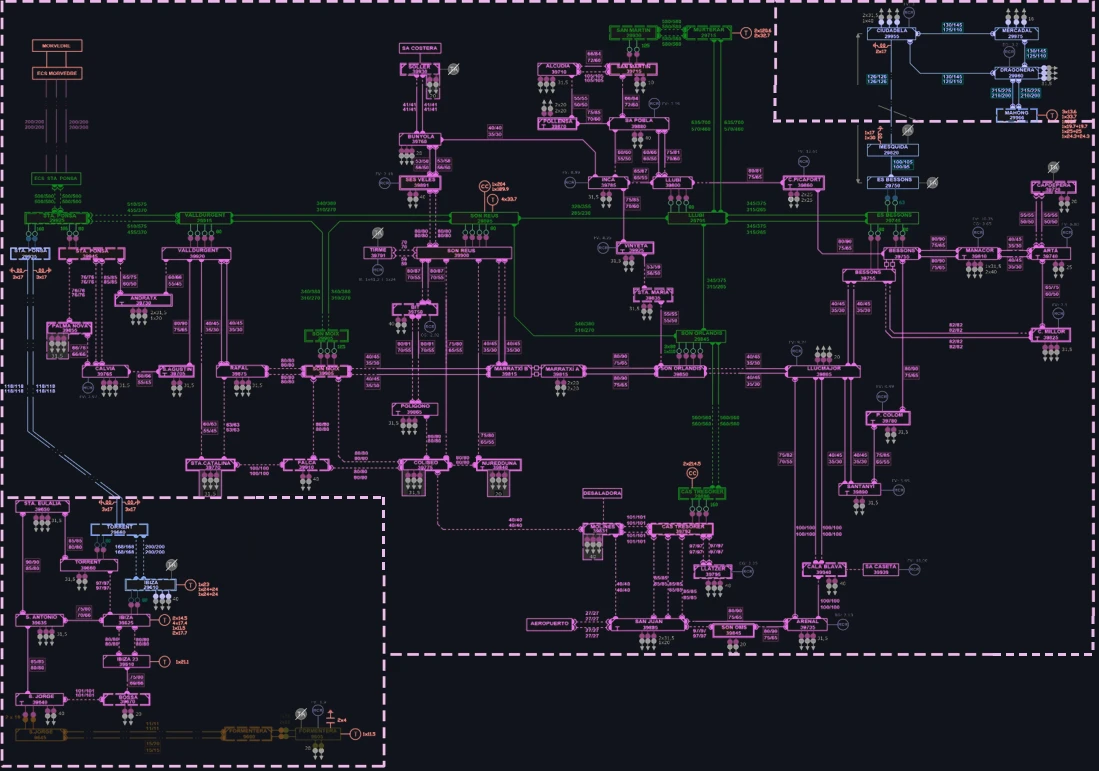
Balearic Islands transmission model in PSCADPublished at CIGRE Paris
The Balearic Islands transmission network, modelled by Velon in PSCAD (published at CIGRE 2024).
PSCAD / EMTDCPowerFactoryPSS®EPython

The studies we run, grouped by the question they answer.

Transients

EMT and ride-through

When converter controls, protection or a weak grid decide the answer, RMS models are not enough. We run detailed PSCAD models with the vendors' own controls.

EMTPSCAD / EMT studiesRead the study
00.10.20.3-101t (s)V (pu)fault
Phase voltages · single-phase faultWhy Shows what the plant does in the first cycles of a fault.
FRTFault ride-through studiesRead the study
00.51V (pu)00.511.501t (s)Iq (pu)fault
Ride-through · voltage and currentWhy The first thing the operator's reviewer checks.
Stability

Oscillations and control stability

Converters can interact with each other and with the network at frequencies RMS tools can't see. We find the risk early, then test the fix.

SSOSSO and impedance studiesRead the study
1ReImmargin−1
Nyquist · loop gainWhy Finds the oscillation before it trips the plant.
CIControl interaction studiesRead the study
00.511.522.5-101t (s)ΔP (pu)ζ = 2%ζ = 15%
Power swing · dampingWhy A retune costs far less than new hardware.
Connection

Connections and compliance

The studies an operator asks for before a plant or a large load can connect, written up clause by clause.

GCCGrid-code compliance studiesRead the study
Compliance matrixWhy Evidence in the form the reviewer expects.
HVDCHVDC and IBR integrationRead the study
00.511.500.51P (pu)V (pu)rated PSCR 1.5SCR 2SCR 3SCR 5
P-V curves · grid strengthWhy Shows whether full output is reachable on a weak grid.
LOADData centre and large-load studiesRead the study
0123hVh (%)3579111317192325
Harmonic voltage · limitsWhy Sizes the filter before the operator asks.
Models

Models that pass review

A study is only as good as its model. We cut large networks down for EMT and build models that pass the operator's checks.

NRRMS to EMT network reductionRead the study
101001k1101001kf (Hz)|Z| (Ω)range of interest
Frequency scan · boundary busWhy Keeps EMT run times practical without losing accuracy.
GBGB EMT model complianceRead the study
  • EMT model
  • RMS model
  • Model checklist
  • Fault ride-through
  • Fast fault current
  • Voltage injection
  • Reactive capability
  • Frequency response
  • SSO screening
  • Validation report
10 items · all produced in-houseWhy One team from the model to sign-off.

Plots are illustrative. Each study page explains the method and what you receive.

From feasibility to post-fault.

What we study at each stage of a project.

01Feasibility & siting

Can it connect here, and what will it take?

  • Load flow & contingency
  • Short-circuit & fault level
  • Point-of-connection optioneering
  • Battery / storage sizing & siting
02Design & FEED

Will the design hold up on this network?

  • Harmonic studies & power quality
  • Protection coordination
  • Complex inverter / IBR modelling
  • Reactive capability & voltage control
03Compliance & submission

Will the system operator accept it?

  • RMS / dynamic stability
  • G99 studies (Type B, C & D)
  • G5/4, G5/5, P28 & P29
  • Fault ride-through & FFCI
04Operation & post-fault

Why did it trip, and how do we stop it recurring?

  • Post-fault root-cause analysis
  • Large-scale wide-area EMT
  • Owner’s engineer & independent review
  • Study automation & repeatability

Codes we work to ENA G99 / G98 ENTSO-E NC RfG NC HVDC IEEE 2800 IEC 61400-27 IEC 60909, 61000 IEEE 519, 1584 ER G5/5, P28, P29 DEWA, TRANSCO, SEC

Selected projects we can talk about.

A few examples from a wider body of work. Most client studies are confidential, so we only show what is already public.

Case 01 · Live

Power-system modelling partner to ET Fuels

We do all of the PSCAD and PowerFactory work for ET Fuels' Power-to-X development in Texas, now at FEED.

Sector
Power-to-X: e-methanol and eSAF
Our role
Power-system modelling and studies
Tools
PSCAD, PowerFactory, Python
Duration
18 months, FEED

More studies under NDA for TSOs, DNOs, developers and OEMs, in the UK and abroad.

Training

The engineers on your study also teach PSCAD.

We have trained TSOs, manufacturers, consultants and users on PSCAD since 2016.

PSCAD training
10+years teaching PSCAD
  • TSOs
  • Manufacturers
  • Consultants
  • Users

When the study repeats, we automate it.

The same engineers build the software and the AI that run studies at scale.

Questions engineers ask us.

What is an EMT control-interaction study, and when do I need one?
It looks at how the fast controls of converters (batteries, solar, wind, HVDC) interact with each other and with the network, at time scales below one cycle. You need one when RMS models can't show the effect: on weak grids, where several converters sit close together, or where equipment from different vendors meets. We run it in PSCAD with the vendors' own control models.
How do you screen for subsynchronous oscillation?
We scan the plant and network impedance across frequency and check stability with the Nyquist criterion. If the scan shows a risk, we confirm it with an EMT run in the time domain, then test the fix.
When should a project move from RMS to EMT?
RMS is fine for load flow, steady state and slower dynamics. Move to EMT when the answer depends on fast converter controls, harmonics, oscillations, ride-through or fast fault current. Most projects use RMS for breadth and EMT for the few cases that decide the result.
How do you work with TSOs and DNOs?
We build and validate models to the operator's requirements, record every assumption and scenario, and present the evidence in the form their reviewer expects. We can also handle the questions that come back from the operator.
What does a study deliver?
Validated model files, the method, the scenarios and operating points, result plots and a written report with recommendations. The exact set depends on the study and on what the operator asks for.

Send the study scope.

A paragraph is enough to start: the plant, the connection point and what the operator has asked for.

  1. 01Send a short brief
  2. 02We reply within two working days
  3. 03We agree scope and method
  4. 04We run the study
Up next · 02 QMerse AI for power grids